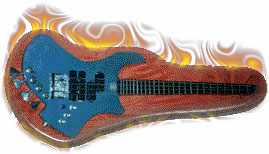
| The Bebb Bass Guitar | |
| VITAL STATISTICS Bass Guitar (4 strings) Scale Length: 30.0" (24 frets) Tuning: Contra-Bass (B-E-A-D) or Bass (E-A-D-G) Construction: Headless Neck-thru-Body with thick slab fretboard Electronics: Active EMG, 1-P and 2-Js |
|
| HISTORY Hand-made, this guitar is the result of nearly twenty years of Bass Guitar Playing, and many many hours of painstaking research. My first exposure to Bass Guitar started with a Fender Precision (what else!), progressed to a Hagstrom short-scale, and shortly thereafter a Japanese Beatle Bass copy. The "Hofney" remained my main axe until it perished at the hands of a jealous girlfriend in the late seventies. It rose from the ashes, the neck grafted onto an "alembic" style solid body, which was outfitted with one of the very first EMG Active mini-humbuckers (which now incidently serves as the HESS rythmn pickup). At the same time I outfitted early EMGs to a couple of Fender Stratocasters and a Gibson Les Paul custom, beginning a love affair with those active EMG pickups which continues to this day... but I digress! Touring in the early eighties did not offer the luxury of traveling with only one bass, so the collection expanded to include a Washburn (which weighed a TON!) and eventually a Rickenbacker. But I was still obsessed with the perfect bass, and having tried (and discarded) various luminaries as Warwick, Spector, Steinberger, and even (much to my dismay) Alembic, I was left with no viable alternative but to do it myself! |
|
| CONSTRUCTION It all started with a trip to our local Exotic Hardwood store. Years of guitar-lust had left me with an appreciation of fine woods. But today was different! The Wood Shop had opened a Woodworking Shop, available by the hour! I purchased twenty hours of shop time, and went out front to pick my wood. As luck would have it, they had just received a 4x4 log of pure black (no dye, no streaks!) african ebony. For a small fortune they agreed to slice a quarter-inch slab off of it, and Bebb was on the way! Then I was faced with the rather daunting task of choosing wood for the neck and body. By this time I had determined that this bass would be a neck thru body machine, with a translucent finish, so I was sorely tempted by an excellent selection of highly figured Koas, Stripey Zebranos, and Gorgeous examples of Birdseye, fiddleback, flamed, and even Quilted maples. But in the end, keeping in mind the bright, ringy, sustaining tone of my rickenbacker, I decided to go for the hardest, tightest grained, clearest Eastern Hard Rock Maple in the store. This became the neck and body (and heart and soul) of Bebb! It was probably one of the hardest decisions I ever had to make, but I decided that due to the exquisite ergonomics planned for this instrument, it would be neccesary to sacrifice figure for tone quality. And I never regretted it! Bebb has a faint wavy open figure thoughout, (clearly visible through the translucent finish) and just the tiniest hint of fiddle on the neck and sides. |
|
| ERGONOMICS As mentioned above, ergonomics was (and is) a key issue for me. Long hours on stage and in the studio had taken a toll on my shoulder, with the (often substantial) weight of the guitar pressing down. At times I found that this disturbed my fretting hand as well. So the number one issue was making the instrument as small (and consequently light) as possible, without sacrificing tonal quality or sustain. Number two issue was simply that of scale length ( a personal preference I admit!) I had spent several years enjoying the 30.5" scale of the Hofner, and the 30" scale of the Rickenbacker. In the end I settled on the 30" scale. Issue Number Three was another ease of use one: going headless allowed me to fret a note and simultaneously adjust the machine head without stretching "way up there..." |
|
| ELECTRONICS I spared no expense. First was the acquisition of an EMG "P" active pickup. Then TWO EMG "J" active pickups. Having these three lovely pickups, I then was faced with how to wire them. In keeping with my desire to absolutely minimize the amount of routing, I managed to find (I was working as an electronics engineer for the federal government at the time) a source for Military Spec electronic parts. So 100 dollars later, I had myself an Ultra-Miniature 4-pole, four position rotary switch. This allowed my to switch the pickups like this:
150 more dollars later, I was the proud possessor of three Bournes "conductive plastic" miniature rotary pots. I opted to use them as follows:
You may notice that I omitted a "tone" control! I generally don't use treble roll-off much (compressors tend to do that for you) and anyway most amplifiers I have used have a fine complement of tone controls. But the Bebb is truly a TONE MONSTER, with a vast array of fundamental and over-tones available for dialing in, particularly with the Switch set to "all three pickups". One last note: in my quest to leave as much of the original wood intact as possible, I opted NOT to mount the 9V battery on board the bass. I had flirted with the idea of mounting Ni-CADs, but thought that could prove a nightmare if I ever took the machine out touring (9-volts are available at 7-Eleven!). In the end I decided to "Phantom Power" the pickups, and built a small outboard power supply to house the batteries. This connects to the bass through a special three conductor cable with a LOCKING connector at the bass end. This cable plugs into the battery box, and the battery box has a regular 1/4" jack to connect to amplifier or direct box (or as I often did, the 1/4" input of a Tube-Tech compressor!). On stage, I would often clip the battery box to my belt (or pop it in my back pocket), connecting it with a short cable to the bass, and another short cable to my wireless transmitter. In the studio, it would normally sit on the console, or an amplifier, connected to the bass by a much longer cable. The Bebb includes the outboard battery box, as well as one short and two long (30') "bass-to-box" cables. |
|
| HARDWARE Pretty Straight Forward: Schaller M4 mini Chrome machine heads & a Schaller fully adjustable brass bridge (Chromed). Also the strap buttons are extra large Schaller Brass ones. Knobs are brushed Aluminum (pickup selector is black anodized). |
|
| FINISH Well, I spent more than my original 20 hours of Woodshop time constructing the Bebb, at this point I decided to Job out the finishing. I did some shopping around, and settled on a shop that specializes in refinishing grand pianos and other custom furniture. The end result was over twenty coats of transparent Aquamarine tinted poly-urathane finish, each coat wet-sanded and allowed to dry. Beautiful AND Indestructable!! Condition: MINT (except for strings, which are pretty old) |
|
| WHAT ELSE Case: Molded Flight Case (Black). Originally designed for a Peavey six-string guitar, its a perfect fit - but it has some additional foam rubber inside to keep the tuners from making contact with the case! Strings: The Bebb does not require special strings. It has been designed keeping in mind the well-documented scientific fact that strings break (and batteries die) with a frequency proportional to the square of the distance between a musician and civilization! The tuners were fitted in such a way that regular 'garden variety' generic "long-scale" bass strings will fit perfectly. Rotosound "SuperWound" short scale (my favorite) fit as well! Fretboard Position Markers: Are for WUSSES!! Actually, there are small white "side dot" dot markers embedded in the side of the fretboard. (3, 5, 7, 9. Double at 12th fret, 15, 17, 19, 21, and Triple at 24th fret.) |
|
| SUBJECTIVE STUFF Sound: it varies - a lot! The tone controls (and various playing approaches) allow for a lot of different sounds. Sustain is very good, in line with a Rickenbacker. Recording Engineers loved it, most of the time they would plug it into a "Tube-Tech" compressor, and then straight to 2 " tape (or ADAT or hard disk!). Playability: exceptional! I am Really picky about this. It is fitted with regular Dunlop Jumbo frets. There is a steel truss rod embedded in the neck, under the thick slab fingerboard. It may be adjusted by removing the truss rod cover, which is actually on old English coin given to me by a drummer friend of mine (also from England). Since it was built, its only had to be tweaked once. (when I re-strung it from a Contra-Bass to a regular E-A-D-G bass). Incidently it started life as a Contra bass (Low "B" string!!) and works brilliantly like this. I only changed over because I was doing a ton of studio work and hated transposing. |
|